
Types of discount (single event)
Promo code
A code the athlete enters when registering (e.g.
RUNNER10). Created and managed inside the event itself.Tier discount
Activated automatically, without a code, for the first registrations or purchases until the quota you define runs out (a “first N slots” type). It is not date-based — it runs out by usage count, not by calendar.
Country discount
Applied automatically based on the country of the athlete registering, without needing a code. Configured on a separate screen — see below.
If you need a free registration, you can achieve it by configuring a 100% discount or marking it as a “free code”. See the note about fees under Discount scope below.
General coupons (multi-event)
Beyond per-event discounts, there is a general coupon type: the same code is created once and made available across several events you choose, instead of repeating the setup event by event. This is useful for sponsors, ambassadors, or brand-wide campaigns spanning multiple events.- Created from a dedicated general-coupons screen, found under the Events menu option (outside any single event’s panel), where you select the events it should work in.
- Shares name, percentage/amount, validity window, and combination rules across all events it’s active in, even though internally a separate entry is stored per event.
- Does not support the “country” type. Country discounts are always configured per event.
- You can still restrict which rates it applies to within each event, just like a normal coupon.
- Editing or deleting a general coupon updates or removes all of its copies across the events it’s active in at once.
- Usage is reported per event, just like any other discount — check each event’s own usage report to see how many times it was redeemed there.
System-generated discounts
These are not created by you — the system generates them to leave an accounting trail for an adjustment, so they show up in the “Discounts Used” reports under recognizable names:If you see one of these names in your usage reports, it’s not an error or a leaked coupon — it’s how the system documents an administrative adjustment or credit.
Discount scope: rates only vs. total purchase
When creating any discount (code, tier, or general), you choose whether it applies to:- Total purchase: registration rates, store products, and custom amount fields. It never reduces the organizer/platform fee, which is always calculated on the pre-discount base.
- Rates only: registration rates exclusively. Products, lodging, and add-ons stay untouched, and the fee is unaffected either way.
Combining discounts
Each discount (code, tier, general, or country) has a stackable? toggle. At most two discounts can apply to the same registration: one automatic tier discount plus one manual coupon — and only if both are marked stackable. As soon as either one is non-stackable, only one of them applies. The system evaluates, in order, when a coupon is applied:- Is there already an active tier discount that is non-stackable? → the new coupon is rejected.
- Is the coupon being applied non-stackable, and is there already a tier discount or a previous coupon? → rejected.
- Is there already a non-stackable coupon applied? → any further discount is rejected.
- Is the athlete trying to apply the same coupon twice? → rejected with a distinct message.
- Otherwise, the new coupon is applied (replacing any previous manual coupon in that checkout session; an active tier discount is kept).
Rate change discount code - Order #...) are the one deliberate exception: they’re created as stackable so they can combine with a coupon or tier discount the athlete already had applied.
Create a discount code
1
Go to 'Discounts'
Inside the event panel, go to Discounts → Manage Discounts and click Add New.
2
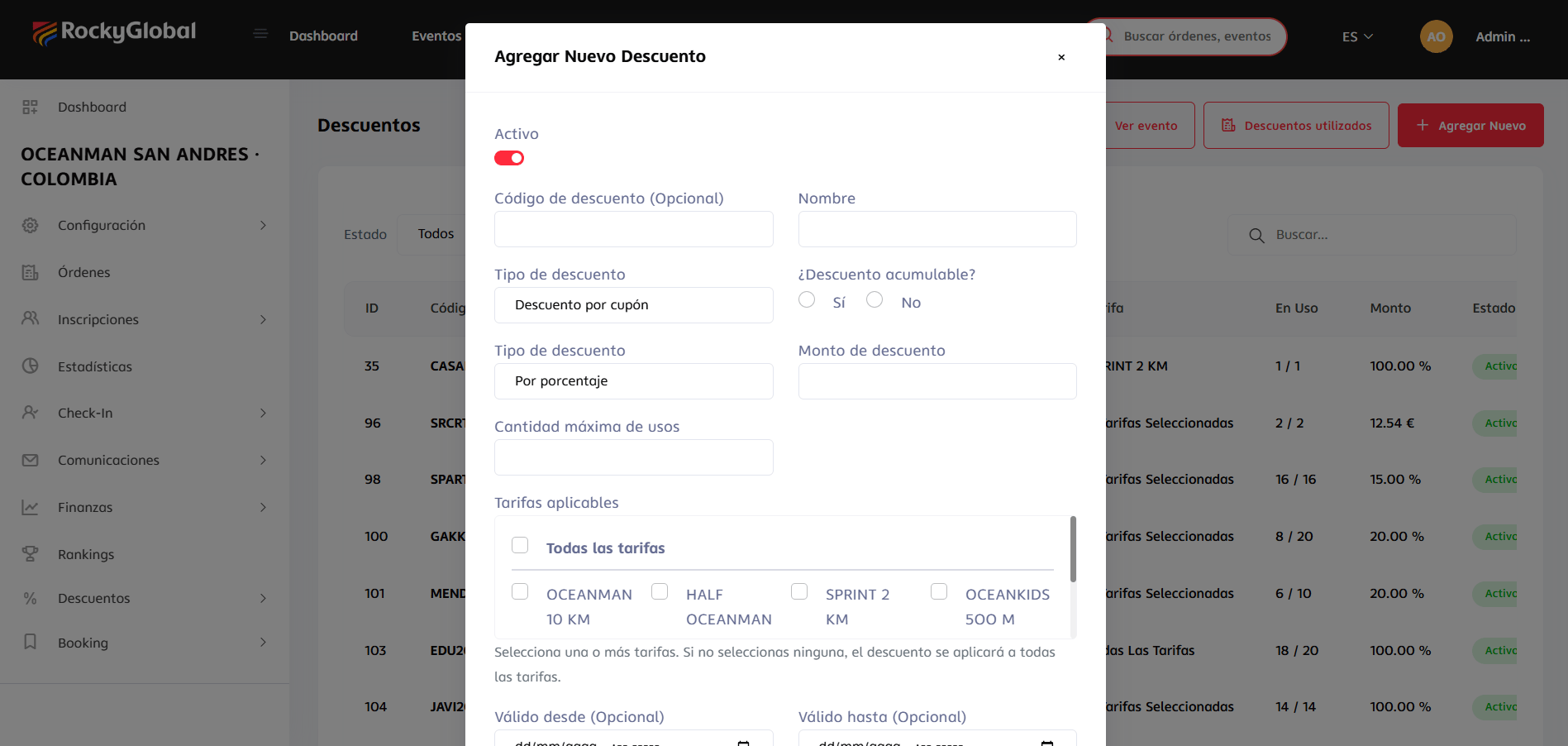
Fill out the form
This same form is used for both “Coupon discount” and “Tier discount” (chosen in Discount Type):
- Active (toggle).
-
Discount code (optional — e.g.
RUNNER10; leave it empty if it’s a “tier” discount, which doesn’t require a code). - Name.
- Discount type: coupon or tier.
- Stackable discount? Yes/No. See Combining discounts above for what this means when the athlete already has another discount applied.
- Value type: percentage or fixed amount (in euros).
- Discount amount.
- Free code (optional): mark this so the registration ends at €0, including the platform fee — unlike a normal discount, which never reduces the fee unless it’s exactly 100%.
- Discount scope: Total purchase (rates + products + custom amounts, never touching the fee) or Rates only (registration rates exclusively; products and lodging stay untouched). Mutually exclusive; defaults to “Total purchase”.
- Maximum number of uses (for “tier” discounts, this is the quota that runs out).
- Applicable fees: select one or several, or none for it to apply to all fees.
-
Valid from / Valid until (optional).
3
Save and share
If it’s a code, share it through your channels (social media, email marketing, sponsors). If it’s “tier”-based, it activates on its own until the quota runs out.
The usage limit is configured at the level of the code as a whole; we’re evaluating adding a per-individual-user limit further down the road.
If you need the same code to work across several events, don’t repeat it event by event: use a general coupon. General coupons don’t support the “country” type.
Country bonuses
This is a different type of discount, with its own screen — it is not created from the form above, but from Discounts → Country Bonuses.1
Go to 'Country Bonuses'
Inside the event panel, go to Discounts → Country Bonuses and click Add bonus.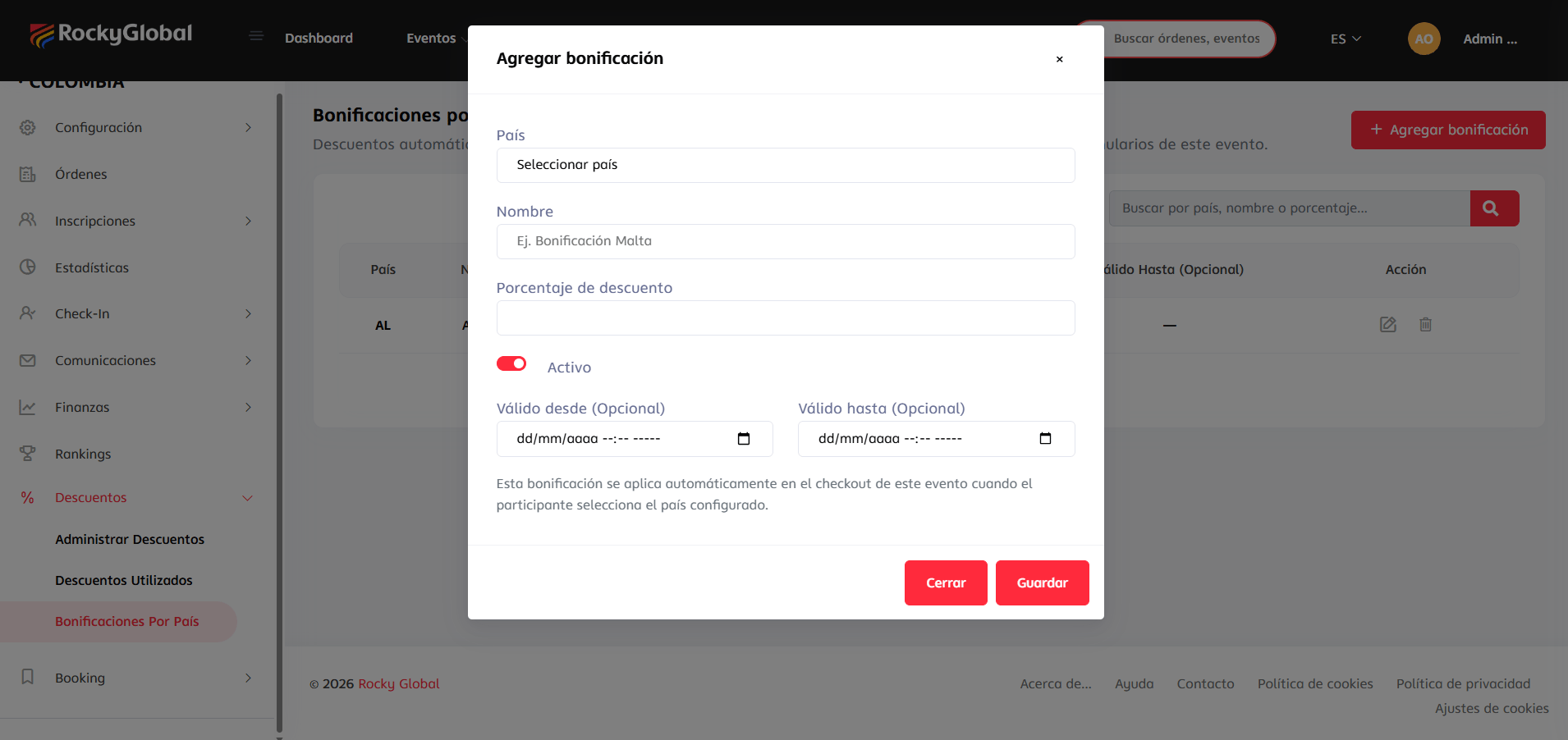
2
Choose the country
Select one country (not multi-select). There can only be one active bonus per country per event.
3
Fill in the details
- Name (optional, e.g. “Malta Bonus”).
- Discount percentage (0.01% to 100%).
- Active (toggle).
- Valid from / Valid until.
4
Save
The bonus becomes active immediately for that country.
You can create several bonuses, one per country, each with its own percentage (for example 10% for one country and 15% for another).
The athlete’s country is taken from the country field they fill in on the registration form (or the country saved in their account, if they’re already logged in) — it is not detected by IP or by the payment card’s country. It is applied automatically at checkout.
Usage reports
In Discounts → Discounts Used you’ll see:- Number of times each code was used.
- Total amount discounted.
- Associated registrations.
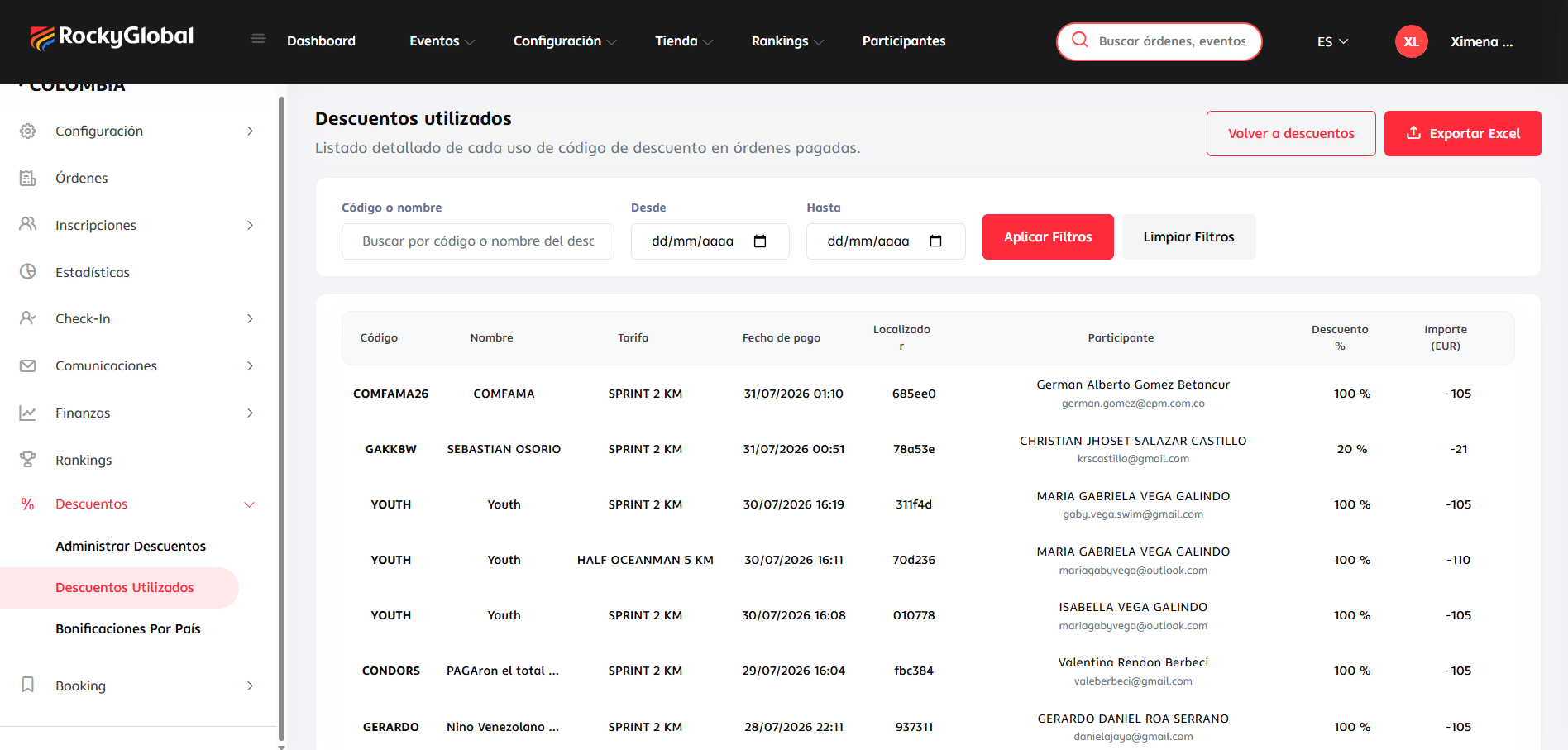
A general coupon is reported per event: if the same code was used across three events, you’ll see its usage reflected separately in each of those events’ reports, not in a combined total.
Manual approval - Order #..., Cancellation discount code - Order #..., or Rate change discount code - Order #... — these are system-generated discounts, not coupons you created, and not an error.